
Using AI to save energy at home with the BC Home Energy Planner
|

Connected Services BC is bringing together people, resources and technology to improve collaboration, reduce duplication and support innovation across government. We’re partnering across government to pilot using artificial intelligence (AI) to improve both service delivery and the employee work experience.
We are currently focused on evaluating workflow patterns where AI technology can be most impactful, including intelligent automation, application modernization, information search and retrieval and information analysis and synthesis.
The work of the Ministry of Energy and Climate Solutions is a great example of using AI for information analysis and synthesis. Read on to learn how they integrated this powerful technology into an intuitive user experience for homeowners.
Energy efficiency is about reducing costs and increasing climate resilience while keeping your home comfortable. However, making a home more efficient is complex, and can be difficult to put into practice.
The BC Home Energy Planner (the Planner) was designed to guide homeowners through every step of improving energy efficiency.
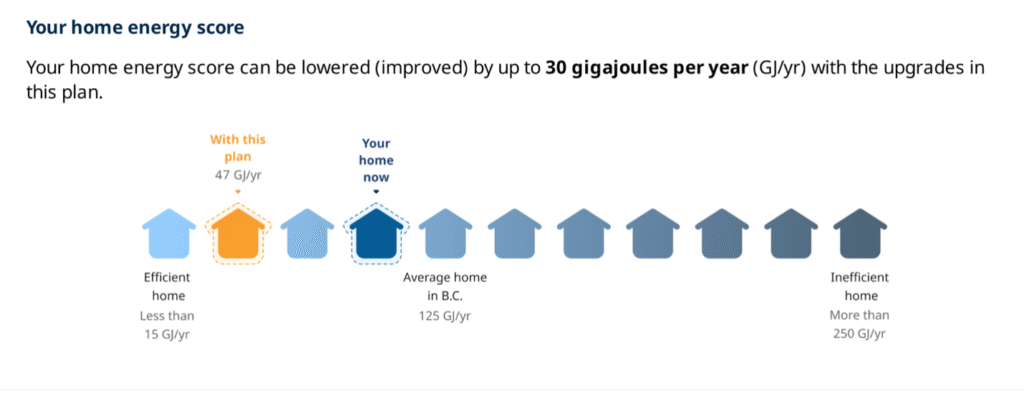
Developed by the Ministry of Energy and Climate Solutions, this free online tool helps homeowners better understand their energy use and provides personalized advice on how to use it most efficiently. Using publicly available data, the Planner estimates a home’s energy score (measured in gigajoules used per year) and suggests upgrades to space and water heating, cooling, insulation and windows to improve efficiency and reduce costs.
“When applied in a critical and thoughtful way, AI and machine learning, digital service design and user testing can help create tools that reduce the burden on homeowners,” says Service Transformation Director Kevin Ehman. This combined approach enables more impactful results than any single element could provide on its own.
How the Planner works
In a traditional on-site home assessment, about 400 attributes of the property would need to be measured and captured with pen and paper.
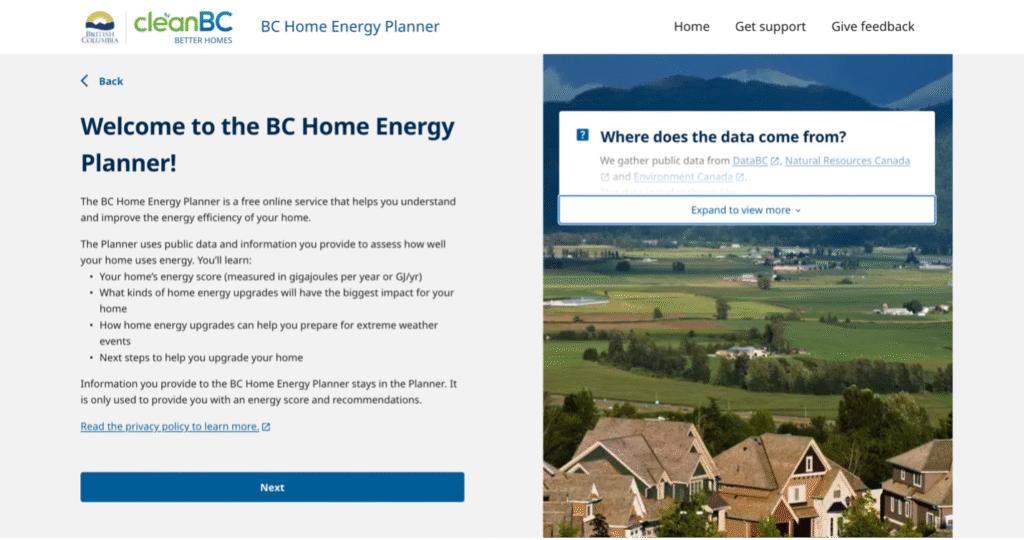
The BC Home Energy Planner simply asks homeowners 11 questions about the structure and features of the home. (The system already has a good guess for the details based on the home’s address and background data like building codes, but the homeowner’s answers provide valuable confirmation.) Then machine learning is used to run simulations based on that data. The resulting model is used to estimate the same 400 attributes that would be tracked in a traditional assessment.
Data inputs come from sources like:
- DataBC
- Natural Resources Canada
- Environment Canada
And include details like:
- The year the home was built
- The size of the home
- The region of the home
This data is used to help provide an energy score for the home, supporting smart and informed decisions to improve comfort and energy efficiency. In the background, the model runs thousands of times to determine the home’s most likely configuration, much faster than a human or even a team of humans could do. That’s the power of AI.
AI for better homes
Homeowners expect tools like this to be accurate and make their lives easier. AI technology works in the background of the Planner to make this possible, so seamlessly that users may not even realize it’s involved.
In the past, the main challenges of calculating a highly-detailed home energy rating were computational and data needs. The process required a physics-based simulation that considered factors like the home’s location and climate. Using conventional methods, assessing over a million homes in B.C. this way would have required significant hardware resources. In recent years, AI and data science advancements have shown a new path for solving this bottleneck.
The Planner is built for maximum accuracy and transparency. To achieve this, it uses safeguarded AI only for the most complex, computationally intensive calculations — replacing traditional physics-based methods where it makes sense. The rest of the process is designed to be clear and explainable, so homeowners can trust and understand the output.
The end result? A complex utilization of AI coupled with an intuitive user experience, representing the best of what the technology can do for people in B.C.
Built for homeowners
When designing the Planner, the team took a user-centred approach to ensure it would be effective, easy and adaptable.
Exploratory questions guided their direction and scope, and user feedback shaped everything – from banner design to whether “BC” should be included in the name. Yes/No user testing helped the team assess the Planner’s flow, make adjustments aligned with user needs and refine the product’s scope.
Reflecting real communities
Throughout this testing, the project team worked closely with public and private sector partners and took an outside-in, user-led approach to testing and feedback. They prioritized diversity among participants, making sure to include homeowners in rural or remote communities where traditional assessments may be harder to access.
“Early in our research, we tried word-of-mouth and snowball recruiting, where we asked people we know for leads on research participants,” said Ehman. “We found willing participants, but they all reflected a similar demographic… and we knew we needed to avoid confirmation bias.” To make the Planner accessible across the province, we hired a recruitment company and asked for geographic diversity, and participants with a range of incomes and education levels. This was especially important because one of our connected services – the Better Homes Energy Savings Program – supports households below a certain income threshold.”
This shift led to broader representation in the Planner, including feedback on visuals. Participants emphasized the importance of relatable imagery – such as homes that reflect a range of price points and everyday living situations. In response, the team diversified the people, homes, and landscapes shown in the Planner, including remote and rural settings, to better reflect the diversity of communities across B.C.
Planning for the future
The Planner is part of the broader CleanBC service portfolio and is evolving to align with other provincial and municipal energy efficiency programs. As the team explores ways to connect it seamlessly with other services and transition to ongoing operations, the goal is to ensure the Planner remains responsive, sustainable and integrated into regular government operations, supporting homeowners in B.C. for years to come.
If you have questions, contact Brett Auger, Product Manager.
Try the BC Home Energy Planner or read more AI case studies highlighting the key results achieved when AI and human intelligence work together.